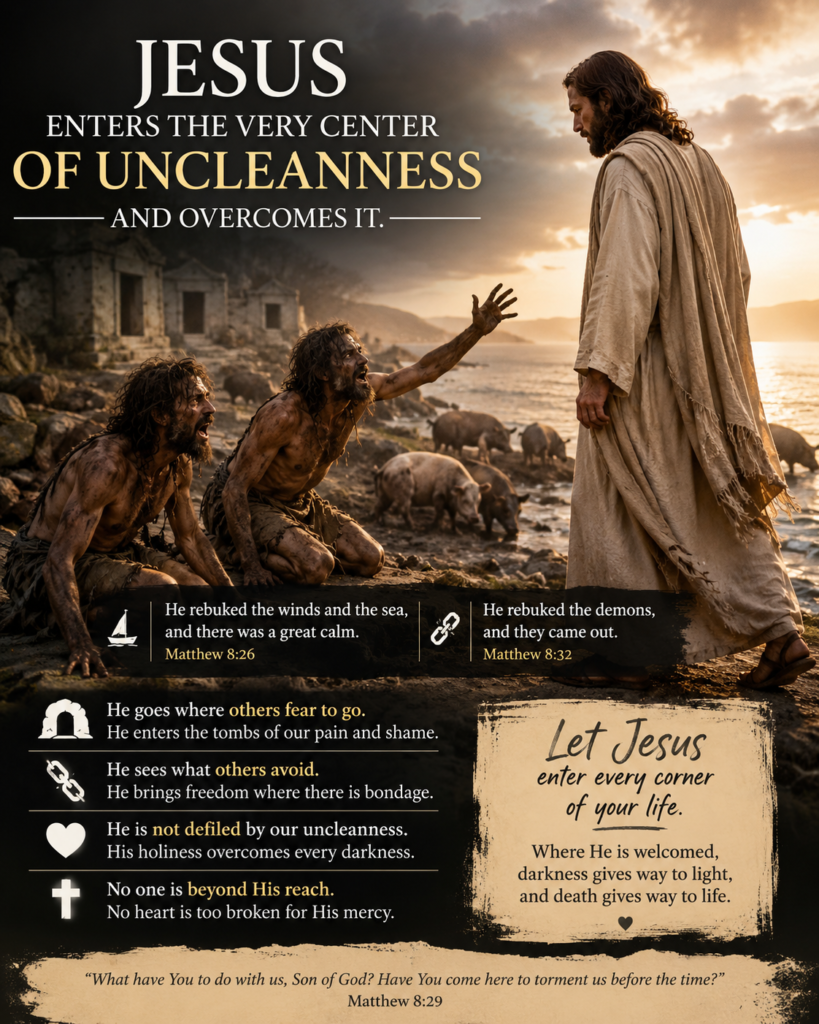
After calming the storm, Jesus deliberately crosses to the other side—the region of the Gadarenes. This is not simply a change of location; it is a journey into a place every faithful Jew would have considered unclean. The land is Gentile territory. Two men live among the tombs, places associated with death and ritual impurity. Nearby grazes a large herd of pigs, animals regarded as unclean under the Law. Matthew intentionally surrounds Jesus with symbols of impurity, darkness, and spiritual bondage.
Yet Jesus does not avoid these places. He enters them.
The Greek text emphasizes that the demon-possessed men come “out of the tombs” to meet Him. While everyone else has learned to stay away because the men are “exceedingly fierce,” Jesus walks toward them. Where others see danger, Jesus sees people who need to be restored.
The demons immediately recognize Him: “What have You to do with us, Son of God?” Ironically, while many people are still discovering who Jesus is, the powers of darkness already know. They also know they are powerless before Him. They cannot act without His permission. A single word from Jesus—“Go!”—is enough to drive them out. There is no struggle, no ritual, no contest. The One who calmed the sea now commands the unseen powers of evil with effortless authority.
This passage reveals an important truth about Christ: Jesus enters the very center of uncleanness and overcomes it. He is not defiled by tombs, demons, or pigs. Instead, His holiness overcomes impurity. His presence drives out darkness. His authority restores what sin and evil have destroyed.
The same is true today. Many people carry “unclean places” within them—hidden sins, painful memories, addictions, resentment, shame, or wounds that they would rather keep buried. Like the townspeople, we sometimes hope Jesus will stay at a distance because allowing Him into those places may require uncomfortable change.
But Christ does not enter our lives to condemn us. He enters to liberate us. No part of our life is too broken, too dark, or too unclean for His saving presence. The places we fear to expose are often the very places where He desires to reveal His healing power.
Sadly, the townspeople respond by asking Jesus to leave. They are more disturbed by the loss of their herd than amazed by the restoration of two human lives. Their reaction challenges us to examine our own hearts. Do we welcome Christ even when His presence disrupts our comfort, our priorities, or our attachments? Or do we, in subtle ways, ask Him to leave because discipleship may cost us something?
The Gospel invites us to do the opposite. Let Jesus enter every corner of our lives. His holiness is greater than our uncleanness. His mercy is stronger than our sin. His authority is greater than every power that seeks to bind us. Wherever Christ is welcomed, darkness gives way to light, bondage gives way to freedom, and death gives way to life.
Leave a Reply